Forget the Recipe: Learn These Cocktail Ratios and Make Anything
Here's a thought that might mess with how you approach your home bar: the best cocktail you'll ever make probably isn't in any recipe book. It's waiting inside a ratio you haven't learned yet.
Most of us start the same way — bookmarking recipes, buying specific bottles for specific drinks, following instructions like we're baking a soufflé. That's not a bad place to start. But it keeps you dependent. The moment you run out of an ingredient or want to try something new, you're stuck. Learning cocktail ratios is how you break out of that loop entirely.
Ratios aren't rigid rules. They're structural frameworks — the architecture underneath every great drink. Once you internalize a handful of them, you stop following recipes and start thinking like a bartender.
What a Ratio Actually Does for You
Think of a ratio as a flavor blueprint. It tells you how much of each type of ingredient to use — spirit, sweet, sour, modifier — without locking you into a single combination. The actual bottles you reach for can change completely. The ratio stays the same, and the drink still works.
This is exactly how working bartenders develop new cocktails. They're not inventing from scratch every time. They're plugging new ingredients into proven structural templates. The creativity lives in the substitutions, not the skeleton.
For home bartenders with a modest collection, this is genuinely liberating. A well-stocked home bar with five or six spirits and a few modifiers can produce dozens of coherent, balanced cocktails — if you know your ratios.
The Sour: The Most Useful Ratio You'll Ever Learn
If there's one ratio to tattoo on your brain, it's the sour: 2:3/4:3/4, or more intuitively, 2 parts spirit, 3/4 part citrus, 3/4 part sweetener.
The Whiskey Sour, the Daiquiri, the Margarita, the Gimlet, the Cosmopolitan — they're all sours. Different spirits, different citrus, different sweeteners, same underlying structure. Once you see it, you can't unsee it.
Swap bourbon for tequila, lime juice for lemon, simple syrup for agave nectar, and you've moved from a Whiskey Sour to a Margarita without changing the ratio at all. Sub in rum and keep the lime? That's a Daiquiri. Use gin with lime and swap the simple syrup for St-Germain? You've just invented something new that actually works, because the proportions are sound.
The sour ratio is also forgiving in the best way. A little more citrus if your fruit is sweet. A touch more sweetener if your spirit is particularly sharp. The ratio gives you the target; your palate makes the final call.
The Daisy: One Small Shift, Whole New World
The Daisy is essentially a sour with a liqueur standing in for the plain sweetener — and that single substitution changes the character of the drink dramatically. The classic ratio runs 2 parts spirit, 1 part liqueur, 1/2 to 3/4 part fresh citrus.
The Margarita, technically, is a Daisy (tequila, triple sec, lime). So is the Sidecar (cognac, Cointreau, lemon). The liqueur brings not just sweetness but its own flavor dimension — orange, elderflower, maraschino, raspberry — which is where the real creative range opens up.
Once you're working with the Daisy template, the combinations multiply fast. Mezcal, Aperol, and grapefruit juice? That's a Daisy. Bourbon, Amaro Montenegro, and lemon? Also a Daisy. The ratio holds; the personality shifts entirely based on what you choose to fill it with.
The Martini: Spirit-Forward Ratios and Why They're Different
Not every great cocktail is built around citrus. Spirit-forward drinks — the Martini, the Manhattan, the Negroni — follow a completely different logic, and the ratio reflects that.
The classic Martini runs 2:1 (spirit to vermouth), though plenty of drinkers go drier at 3:1 or even 4:1. The Manhattan mirrors that structure almost exactly — whiskey and sweet vermouth in roughly the same proportions, with bitters playing the supporting role.
The Negroni is the famous equal-parts exception: 1:1:1, gin to sweet vermouth to Campari. It's one of the most copied templates in modern bartending because it scales so cleanly. Swap the gin for bourbon and you've got a Boulevardier. Sub mezcal for gin and something shifts in the smoke-bitter interplay that feels like a whole new discovery.
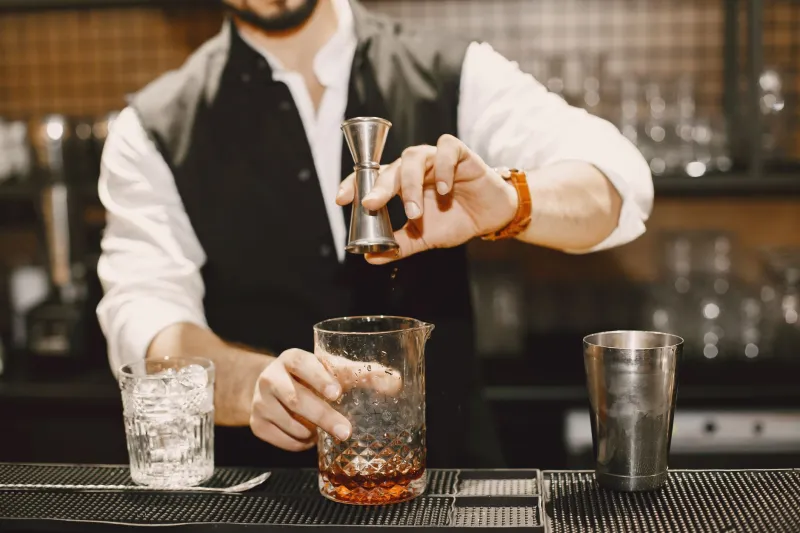
What these spirit-forward ratios share is a respect for the base spirit. There's no citrus to hide behind. The proportions have to be right, the ingredients have to be quality, and the dilution from stirring has to do its job. These are slower, more contemplative drinks — and the ratio is doing heavier structural work than it might seem.
The Highball: Simplicity Is a Ratio Too
Don't overlook the highball. It's often treated as a non-cocktail — just spirit plus mixer — but the ratio matters enormously here. The sweet spot for most highballs is roughly 1 part spirit to 4 parts carbonated mixer, though 1:3 works for a stronger build.
What kills a highball isn't usually the quality of the ingredients. It's the wrong ratio, or pouring the spirit into warm ice, or stirring too aggressively and killing the carbonation. The highball is proof that ratios apply even when the drink looks dead simple.
A proper Japanese-style highball — whisky, ice-cold soda, precise dilution — is one of the most technically considered drinks in the world. It just doesn't look like it.
How to Start Using Ratios in Practice
The best way to internalize these frameworks is to build the same ratio with three different ingredient combinations back to back. Make a Daiquiri, then swap the rum for tequila and the lime for lemon with a little orange liqueur. Notice what changes and what stays structurally consistent. Your palate will start to map the template.
Keep a small notebook (or a notes app — no judgment) where you log substitutions that worked. Over time, you're building a personal flavor library organized around ratio families rather than individual recipes.
And when you're standing at your bar with a bottle you've never used before and no recipe in sight? Pick your ratio, match your modifiers to the spirit's character, and trust the structure. That's what it means to actually mix.
The Real Payoff
Recipes are someone else's answer to a specific question. Ratios are the question itself — and learning to ask it correctly is what separates a home bartender from someone who just follows instructions.
You don't need a bigger bottle collection. You need a better understanding of how the bottles you already own relate to each other. Nail the sour, the daisy, the Negroni template, and the highball, and you've got the foundation for hundreds of drinks — including a few the world hasn't tasted yet.
That's the real good stuff.