The Bar Spoon Is the Most Underrated Tool You Own — Here's How to Actually Use It
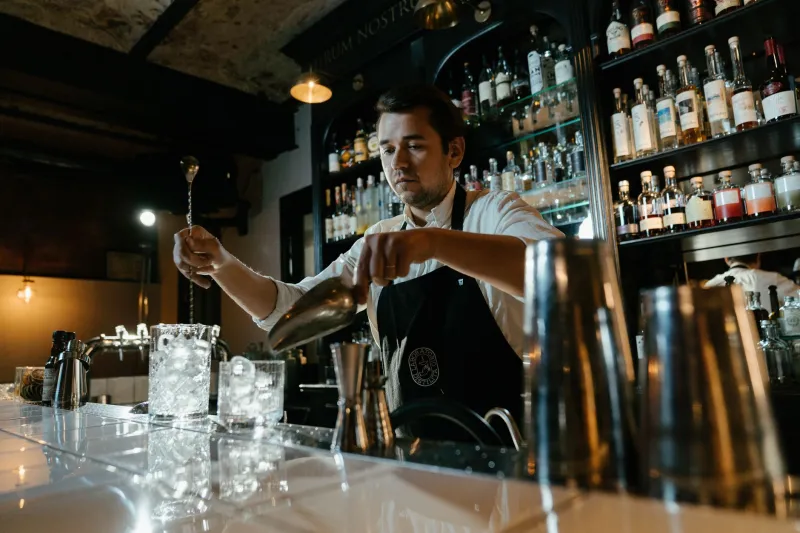
Walk into any serious cocktail bar in the country and watch what happens when someone orders a Negroni or a Manhattan. The bartender doesn't reach for the shaker. They pick up a long, twisted bar spoon, drop it into a mixing glass full of ice, and start moving — slow, deliberate, almost meditative. It looks effortless. It looks like nothing. And that's exactly the point.
At home, most of us skip straight to the shaker for everything. It's satisfying. It feels like you're doing something. But here's the honest truth: for spirit-forward cocktails, shaking is often the wrong call — and learning to stir properly might be the single biggest upgrade you can make to your home bartending game.
Why Stirring Isn't Just "Mixing Without Shaking"
The difference between stirring and shaking isn't just technique — it's physics. When you shake a cocktail, you're introducing air. Thousands of tiny bubbles get trapped in the liquid, which creates that slightly frothy, opaque texture you see in a freshly shaken drink. For citrus-heavy cocktails like a Daiquiri or a Whiskey Sour, that aeration actually helps. It lifts the flavors and softens the acidity.
But pour spirits-only drinks — your Martinis, your Negronis, your Boulevardiers, your Vieux Carrés — into a shaker and you're doing them a disservice. Those drinks are built on clarity. They're supposed to be crystal clear, silky smooth, and bracingly cold without the cloudiness or over-dilution that aggressive shaking brings. Stirring chills and dilutes the drink at a controlled rate, keeping the texture dense and the appearance pristine.
Professional bartenders often say that anyone can learn to shake. Stirring well takes patience — and patience, it turns out, is a skill.
Getting the Grip Right
Here's where most home bartenders go wrong immediately: they hold the bar spoon like a pencil. Don't do that.
The proper grip involves placing the spoon between your index and middle fingers, with the twisted handle resting against your ring finger. Your thumb acts as a light guide on the back of the spoon. The goal is for the spoon to rotate against the inside wall of the mixing glass while the back of the spoon — not the bowl — does the actual stirring work.
When done correctly, the spoon traces a continuous circular path along the inner wall of the glass. The ice rotates as a unit. The liquid moves with it. There's almost no splashing, no clinking, no drama. It should look like the drink is stirring itself.
If your ice is jumping around or you're hearing a lot of noise, you're using too much force. Dial it back. The motion is in the wrist, not the arm.
Counting Reps and Dialing In Dilution
One of the most common questions beginners ask: how long do you actually stir? The honest answer is that it depends on the drink and your ice, but a good starting baseline is around 30 to 40 full rotations for most spirit-forward cocktails. That typically translates to somewhere between 20 and 30 seconds of continuous stirring.
Here's the thing — you're not just chilling the drink. You're also diluting it. Water is an ingredient in every cocktail (we've talked about this before), and stirring is how you control exactly how much gets in. Under-stir and the drink is too boozy and not cold enough. Over-stir and you've watered it down past the point of no return.
A few variables affect this:
- Ice quality matters a lot. Large, dense ice cubes from a tray (or better yet, a clear ice mold) melt more slowly and give you more control. Thin, airy freezer ice melts fast and can over-dilute quickly.
- Room temperature affects your timing. On a hot summer evening in, say, Houston or Miami, your ice is working harder. You might need to move a little faster or use more ice to compensate.
- The proof of your spirits changes the equation. Higher-proof ingredients need slightly more dilution to open up properly.
If you want to geek out on this, invest in a small cocktail thermometer. A well-stirred Martini should land somewhere around 23 to 28 degrees Fahrenheit before it hits the glass. Once you've hit that target a few times by feel, you'll stop needing the thermometer.
The Ritual Is Part of the Drink
There's something else going on with stirring that doesn't get talked about enough: the experience of it.
Cocktail culture in the US has spent the last decade and a half celebrating the theater of the shake — the tin crashing down, the ice rattling, the dramatic double strain. And sure, that's fun. But stirring has its own kind of theater, and it's quieter, more intimate. It's the kind of thing that makes guests lean in rather than step back.
When you stir a drink in front of someone — slowly, deliberately, with a well-chilled mixing glass fogging up in your hand — it signals that you know what you're doing. It says this drink deserves care. It creates a moment of anticipation before the pour.
Professional bartenders often describe spoon work as the real tell of someone who's taken the craft seriously. Shaking looks impressive. Stirring looks like mastery.
The Pour: Don't Rush the Finish
Once you've stirred to your satisfaction, the pour matters more than people realize. Use a julep strainer (the perforated disc-shaped one) seated inside the mixing glass at an angle. Pour in a slow, steady stream — not a dump. This keeps the drink smooth and prevents splashing that can introduce unwanted aeration right at the finish line.
If you're making a Martini, the glass should already be chilled. A cold coupe or Nick & Nora glass straight from the freezer makes an immediate difference. Pouring a perfectly stirred drink into a warm glass is like ironing a shirt and then balling it up.
A Few Drinks Worth Practicing On
If you want to build your stirring chops, start with these:
- Negroni (equal parts gin, sweet vermouth, Campari) — forgiving enough to practice on, distinctive enough that you'll notice the improvement immediately
- Classic Martini (gin or vodka with dry vermouth) — unforgiving and clarifying; every mistake shows up here
- Manhattan (rye or bourbon, sweet vermouth, bitters) — a great vehicle for understanding how dilution affects whiskey's spice and sweetness
- Vieux Carré (rye, cognac, sweet vermouth, Bénédictine, bitters) — complex and rewarding; a great confidence builder once you've got the basics down
Give the Spoon Its Due
The bar spoon has been around longer than the cocktail shaker. It's quieter, more precise, and in the right context, produces a better drink. It just asks something the shaker doesn't: your full attention.
Next time you're making something spirit-forward, put the shaker down. Pick up the spoon. Take your time. You might be surprised how much a little patience changes what ends up in the glass.


