Float, Sink, or Blend: The Real Science of Layered Cocktails

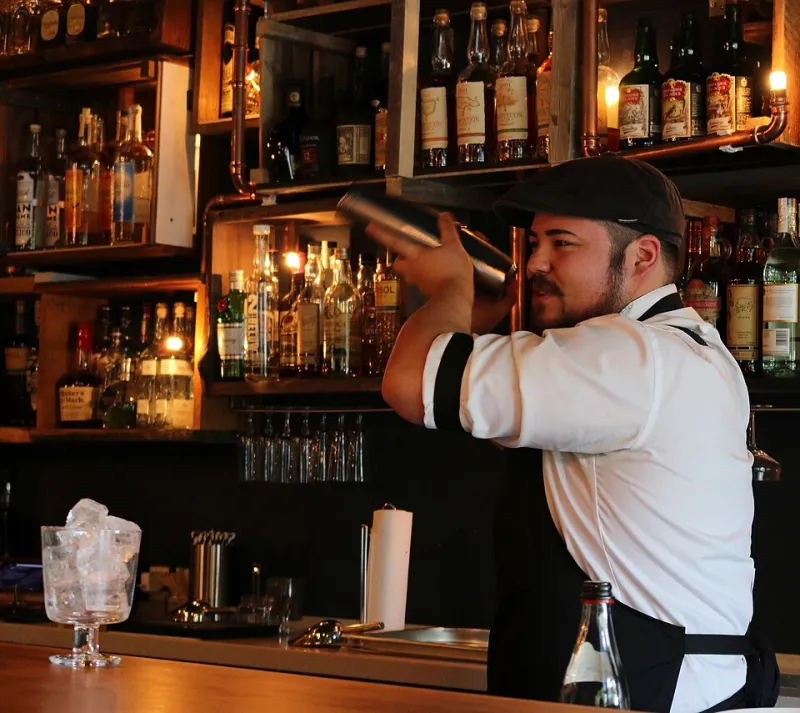
Photo by Photo by Sean Hsu on Unsplash on Unsplash
There's something almost hypnotic about a perfectly layered cocktail. That gradient of deep red bleeding into amber, or a vivid blue horizon floating above a golden base — it looks like a trick, like the bartender cheated somehow. And honestly? In a way, they did. They cheated gravity. Or at least, they understood it well enough to work with it.
Layered cocktails aren't just an Instagram flex. They're one of the most technically demanding things you can do behind a bar, and the reason they work — or catastrophically don't — comes down to some genuinely interesting science. Let's get into it.
It All Starts With Density
Every liquid has a density, measured by how much mass is packed into a given volume. Water sits at 1.0 g/mL. Liquids denser than water sink below it; lighter ones float above. When you're building a layered drink, you're essentially stacking liquids in order of density, heaviest at the bottom, lightest at the top.
Sounds simple, right? It is — until you realize that density in cocktail ingredients is determined by three overlapping factors: sugar content, alcohol content, and temperature. And those three things are constantly in tension with each other.
Sugar increases density. The more dissolved sugar a liquid contains, the heavier it becomes. That's why grenadine, a heavily sweetened pomegranate syrup, almost always sits at the bottom of a drink — it's dense enough to anchor everything above it. Liqueurs like crème de cassis or coffee liqueur behave similarly.
Alcohol, on the other hand, decreases density. Pure ethanol is lighter than water, which means higher-proof spirits float more readily. A 100-proof bourbon is less dense than a 40-proof liqueur with comparable sugar content. This is where home bartenders often get tripped up: ABV and sweetness pull in opposite directions, and the final density of any given bottle is a product of both.
Temperature adds another wrinkle. Cold liquids are denser than warm ones, so a chilled layer can temporarily hold in place even when its base density wouldn't otherwise support it. This is useful to know, but it also means layers in a warming glass will eventually start to blur — which is actually fine, because most layered drinks are meant to be consumed quickly.
The Pousse Café and Why It's Basically a Physics Exam
If you want to see density layering taken to its logical extreme, look up the Pousse Café. It's a classic European cordial drink — popular in 19th-century American saloons too, actually — that stacks anywhere from three to seven distinct liqueur layers in a narrow cordial glass, each one a different color. A well-made Pousse Café looks like a striped candy, and building one correctly requires knowing the exact specific gravity of every ingredient you're working with.
The traditional order goes something like this: grenadine on the bottom, then maraschino, crème de menthe, crème de violette, Chartreuse, orange curaçao, and brandy floating on top. Each layer is poured slowly over the back of a bar spoon to minimize turbulence at the surface. One wrong move — too much force, too warm a liquid, two adjacent layers with nearly identical densities — and the whole thing collapses into a murky purple-brown disaster.
The Pousse Café fell out of fashion for most of the 20th century, probably because it's genuinely annoying to make and moderately annoying to drink. But its principles never went away. They just migrated into tiki drinks, craft cocktails, and, yes, the kind of drinks people photograph at rooftop bars.
Practical Layering for the Home Bartender
You don't need to memorize specific gravity tables to pull off a layered cocktail at home. What you need is a basic intuition for where common ingredients fall on the density spectrum, plus a steady hand and a bar spoon.
Know your anchors. The following ingredients are reliably dense and work well as base layers: grenadine, simple syrup, blue curaçao, coffee liqueur (like Kahlúa), and crème de cassis. Build your drink starting with these.
Know your floaters. High-proof spirits — especially those with low sugar content — sit near the top. Overproof rum (like Wray & Nephew or Plantation OFTD) is a classic float. Cream liqueurs like Baileys are surprisingly floatable due to their fat content. Dry spirits like gin or white rum at standard proof will float over sweet liqueurs.
Use the back of a bar spoon. This is the non-negotiable technique. Hold the spoon just above the surface of the liquid already in the glass, convex side down, and pour the next layer slowly over it. The spoon disperses the incoming liquid across a wider surface area, reducing the kinetic energy that would otherwise punch through the layer below. Go slow. Seriously, slower than you think.
Chill your ingredients. Cold liquids are more viscous and slightly denser, which helps them hold their shape during pouring. Keeping your layering ingredients refrigerated before building the drink gives you a little more margin for error.
Choose a narrow glass. The less surface area you're pouring across, the easier it is to control the layers. A highball or Collins glass works well for two- or three-layer drinks. For something more intricate, a narrow cordial or shot glass is your friend.
When the Layers Are Supposed to Blend
Here's a thing worth saying out loud: not every layered cocktail is meant to stay layered. The tequila sunrise is probably the most famous example — that sunset gradient of orange juice and grenadine is beautiful in the glass, but the whole point is that you stir it before you drink it. The visual is the experience, not the flavor architecture.
Same goes for a lot of modern cocktails that use a float of heavy cream, flavored foam, or a high-proof spirit on top. The float changes the first sip — you get that concentrated layer before it integrates — and then the drink evolves as you work through it. That's not a flaw. That's intentional design.
The question to ask yourself before building a layered drink isn't just can I keep these layers separate? It's do I actually want to?
The Honest Case for the Technique
Some bartenders dismiss layered cocktails as pure showmanship — style over substance, the kind of thing that looks great on a phone screen and tastes like nothing in particular. And yeah, there are bad layered cocktails in the world. There are also bad stirred cocktails and bad shaken ones.
Done right, layering is a legitimate technique with real flavor implications. A rum float on a tropical drink delivers a burst of boozy, funky complexity before the sweetness underneath takes over. A cream layer on an espresso martini smooths the edges of the coffee's bitterness on the first sip. These aren't just tricks — they're ways of controlling how flavor unfolds in time.
That's what good mixology is about, whether you're behind a bar at a craft cocktail lounge in Nashville or shaking things up in your own kitchen. Understanding why something works gives you the power to make it work on purpose, every time. And a drink that looks this good while doing it? That's just a bonus.